Best ASO tools for 2027: the stack to use and what's changing in app store search
Plan your ASO for 2027: the free and paid app store optimization tools to use at each stage, and the store changes that affect keywords and listings next year.
· 4 मिनट में पढ़ें
Short answer: for 2027, build your ASO stack in layers. Everyone needs the free base: App Store Connect and Play Console for real search numbers, and free keyword tools for research and rank checks. Add a rank tracker (such as Astro or an Appfigures starter plan) once you track more keywords than you can check by hand, and a full platform (AppTweak, Sensor Tower or MobileAction) only when competitor or market data changes your decisions. What changes in 2027 is less about tools and more about the stores: Apple's AI-generated App Store tags, more listing details on Google Play in Europe and the UK, and app discovery through AI assistants.
We wrote this in November 2026 and will update it during 2027. For today's tool-by-tool comparison, see the best ASO tools in 2026.
Which ASO tools should I use in 2027?
Match the tools to your stage instead of buying the biggest platform first:
| Stage | What you need | Tools |
|---|---|---|
| Before launch | Keyword ideas, difficulty, listing that fits the limits | Keyword suggestions, keyword difficulty, character counter, ASO audit |
| First months live | Weekly rank checks, store traffic numbers | Rank checker, App Store Connect, Play Console |
| Tracking 20+ keywords or several countries | Daily rank history and alerts | Astro (App Store), Appfigures, AppTweak |
| Portfolio or paid growth | Competitor, market and ads keyword data | AppTweak, Sensor Tower, MobileAction |
The links above are TrueLaunch's free tools, which we built. They work for both stores without sign-up.
What will change in app store search in 2027?
These are the changes already announced or under way as of late 2026. Check the stores' own documentation as they roll out.
- App Store tags. Apple said at WWDC 2025 that the App Store would use tags generated with AI from an app's metadata to help people find apps. Your title, subtitle, description and screenshot captions matter more as a whole, so write them for people, not as keyword lists. Your keyword field still counts (iOS keyword field best practices).
- Google Play in the EEA and UK. From March 1, 2027, Google Play shows traders' contact details and a terms of service link on listings there. Declare your status in Play Console by February 1, 2027 (how to declare your trader status).
- Apple Ads. Apple Search Ads is now called Apple Ads. Its keyword popularity indicator is still the closest thing to an official App Store demand signal (see App Store search volume explained).
- Discovery outside the stores. More people ask AI assistants and web search which app to use. A clear website and listings on independent sites help those answers find you (SEO for app websites).
Which ASO tools will matter more in 2027?
- Tools that show the store's own signals. Autocomplete suggestions, live rankings and the stores' dashboards reflect what the stores actually do. Estimates built on old data age quickly when search changes.
- Testing tools. Product Page Optimization on the App Store and store listing experiments on Google Play let you prove that a new icon, screenshot set or text works before you keep it (app screenshots and icons that convert).
- Custom pages. Custom product pages and custom store listings let you match different searches and campaigns (custom product pages and custom store listings).
What won't help: tools or services that promise rankings through fake installs, paid reviews or rating swaps. Both stores remove apps for that, and it never builds lasting rankings.
A simple ASO plan for 2027
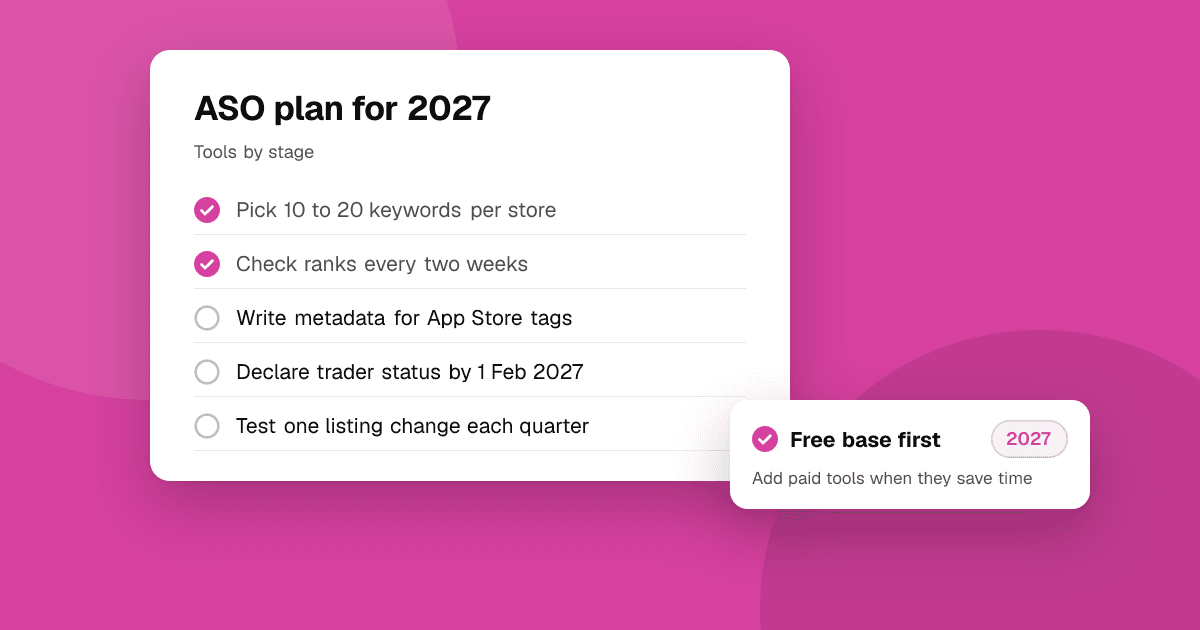
- January: list your 10 to 20 target keywords per store and country, with keyword difficulty to pick ones a small app can win (long-tail keywords for apps).
- Every two weeks: check your positions with the rank checker and record them in a sheet (how to track keyword rankings).
- Every quarter: change one thing in your listing (title, subtitle, screenshots or description) and compare search impressions before and after in the store dashboards.
- When it's tedious: move tracking into a paid rank tracker. Keep your spreadsheet history so nothing is lost.
- Before February 1, 2027: finish the Google Play trader declaration if you publish on Google Play.
Next steps
Start the plan today: run your main keyword through the rank checker to get your first data point for 2027, then read how to research app store keywords for the full method. When your listing is ready, submit your app to TrueLaunch for free.
Frequently asked questions
What is the best ASO tool for 2027?
There isn't one best tool for everyone. Start with the free stores' dashboards and free keyword tools, add a rank tracker such as Astro or Appfigures when you track many keywords, and choose a full platform like AppTweak, Sensor Tower or MobileAction only if you need competitor or market data.
Is ASO still worth doing in 2027?
Yes. Store search is still one of the main ways people find apps, and it's free traffic. What changes is how the stores read listings, such as Apple's AI-generated App Store tags, so clear, honest metadata matters more than keyword stuffing.
What are App Store tags?
Apple announced at WWDC 2025 that the App Store would use tags generated with AI from an app's metadata to help people discover apps. Write your title, subtitle, description and screenshot captions clearly so the tags describe your app well.
Do I need a paid ASO tool in 2027?
Not to start. Free tools cover keyword research and rank checks for both stores. A paid tool saves time once you track many keywords in several countries every day, or need data about competitors and the market.