Google Play policy update October 2026: every change and deadline for developers
Google Play's October 29, 2026 policy update in plain words: location, READ_CALL_LOG, local network, contacts, AppFunctions and the dates you must act by.
· 5 menit baca
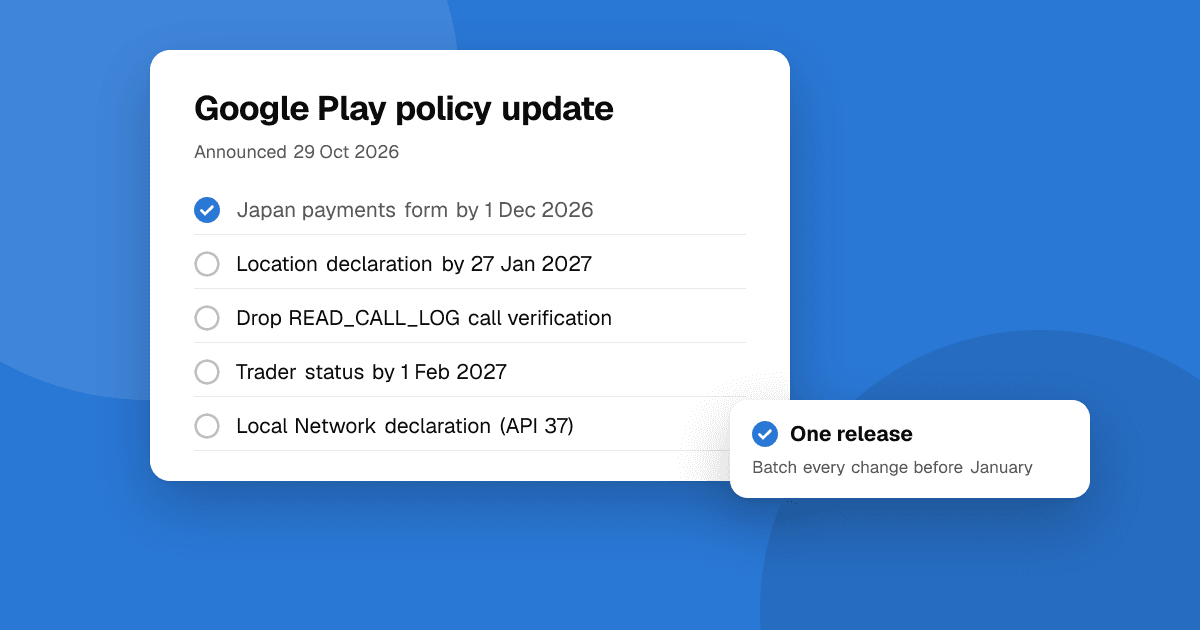
Short answer: Google's policy announcement of October 29, 2026 adds two new permission declarations (Local Network for apps targeting Android 17 and Manage Contacts), a policy for AppFunctions (actions AI agents can call in your app), stricter location rules and a READ_CALL_LOG change, both mandatory on January 27, 2027. It also reminds developers about trader status, a Japan payments deadline on December 1, 2026 and app quality rules due in February 2027. Developers get at least 30 days from the announcement for most changes.
Here is each change, who it affects and what to do. Dates are as of November 2026; Play Console and the Policy Deadlines table have the final word.
Which changes have a deadline?
| Date | Change | Who must act |
|---|---|---|
| December 1, 2026 | Japan payments authorization | Sellers selling into or out of Japan (Payments Center form) |
| January 27, 2027 | Location: minimum scope and precise location declaration | Every app that requests location |
| January 27, 2027 | READ_CALL_LOG can't be used for phone-call account verification | Apps that verify accounts by reading the call log |
| February 1, 2027 | Trader status declaration (existing accounts) | Every developer account |
| February 2027 | App quality: memory and code optimization | Apps that miss Google's new quality thresholds |
What changes for location permissions?
Apps must request the minimum location scope their core features need. For apps targeting Android 17 (API 37) or higher, the new location button is required for one-time precise location, and every app that requests ACCESS_FINE_LOCATION must complete a Play Console declaration. This is the change that affects the most apps, so it has its own guide: Google Play location permission policy for January 27, 2027.
What changes for READ_CALL_LOG?
From January 27, 2027, account verification through a phone call is no longer an allowed use of READ_CALL_LOG. If your sign-up reads the call log to confirm a "missed call" verification, switch to another method. Google points to the SMS User Consent API as a privacy-friendly alternative for one-time codes.
The same update allows government and authorized mobile network operator apps to use READ_CALL_LOG for quality-of-service reporting, and says backup-and-restore apps must show they can restore data to the device's default handler.
What is the Local Network permission declaration?
Apps targeting API level 37 (Android 17) or higher that use the new local network permission must submit a Play Console declaration. Use is limited to core features where the system's device pickers aren't enough, such as an app that controls smart home devices or casts to many kinds of devices on the network. If a system picker can do the job, use it and skip the permission.
What is the Manage Contacts permission policy?
Apps that need the Manage Contacts permission for a core feature, where the system contact pickers aren't enough, must submit a declaration. Everyone else should use the narrowly scoped platform intents, which let the user pick or add a single contact without giving your app the whole address book.
What is the AppFunctions policy?
AppFunctions let your app expose actions that AI agents on the device can call, like "add this to my shopping list". The new policy says your existing policies still apply, and that AppFunctions must not deceive or manipulate AI agents, get around security controls or interfere with other apps. Describe each function honestly and make it do exactly what it says.
What else changed?
- Subscriptions with eligibility discounts. If a subscription discount depends on something like student status, you must clearly explain who qualifies, how it's verified and what the price becomes when the user stops qualifying. Our guide to free trials covers how to show prices honestly.
- Payments through AI. New guidance covers apps that let users buy digital goods through AI or agent experiences.
- Deceptive behavior. Google clarified that you can't manipulate the app review process.
- Accessibility API. Clarified how to use the
isAccessibilityToolflag and what to disclose. - All files access. The minimum scope rules were restated for
MANAGE_EXTERNAL_STORAGE. - Families Self-Certified Ads SDK Program is open to new applicants.
- Cryptocurrency. Hong Kong licensing now includes the Virtual Asset Trading Platform license.
Which reminders matter for indie developers?
- Trader status. Every developer must declare trader status in Play Console. See how to declare your Google Play trader status.
- Play Age Signals is launching globally, so you can adjust features and safety settings by age range.
- App quality. Memory and code optimization thresholds become a compliance requirement in February 2027. The same month brings the 16 KB page size requirement.
- Games for cars. The games category is now generally available for cars.
What should I do this week?
- Open Play Console's Policy status and Inbox pages: Google lists what applies to your app there.
- Check your release build's merged manifest for location, call log, contacts and local network permissions, including ones added by SDKs.
- Fill in any declarations, then plan one update that covers location, 16 KB pages and your target API level.
Next steps
Batch these into a single release in December, test it on a closed track, and ship before the January rush. When it's live, put it on TrueLaunch to get feedback from real people on the updated build.
Frequently asked questions
What is the deadline for the October 2026 Google Play policy changes?
Developers get at least 30 days from October 29, 2026 for most changes. The location and READ_CALL_LOG changes are mandatory from January 27, 2027, and the Japan payments authorization is due December 1, 2026.
Can I still use READ_CALL_LOG for phone-call verification?
Not after January 27, 2027. Account verification through a phone call is no longer an allowed use. Google suggests the SMS User Consent API for verification codes.
Who needs the Local Network permission declaration?
Apps targeting API level 37 (Android 17) or higher that use the local network permission. It's only allowed for core features where system device pickers aren't enough.
Where do I see which policy changes affect my app?
In Play Console, check the Policy status page and the Inbox. Google lists the declarations and deadlines that apply to each app there.